
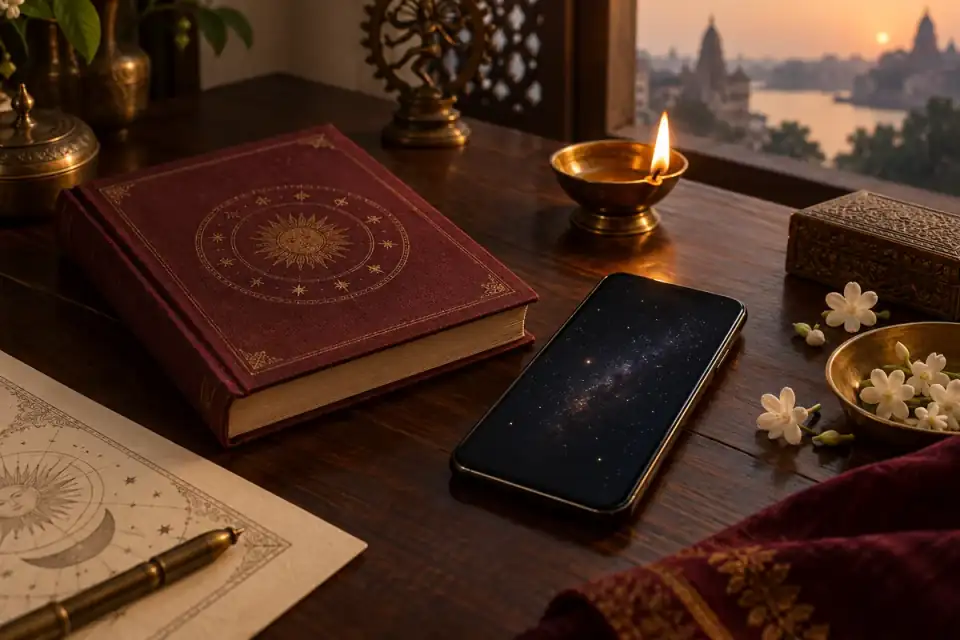
The horoscope arrives almost immediately. It is neatly arranged, reassuringly personal and confident enough to sound as though someone has known you for years. You have supplied a birth date, a time and a town. In return, a screen has supplied a story about your life. The speed is impressive. So is the temptation to believe the voice.
There is an especially intriguing meeting of worlds here. Jyotish has a long relationship with calculation: calendars, planetary positions and the exactness of a birth moment matter to its practice. Software is therefore no stranger at the astrologer’s desk. What is newer is the conversational machine that moves so smoothly from calculating a chart to telling you what it means.
Those tasks can look identical on a phone. They are not identical in practice. An astronomical engine can calculate where a planet was. A language model can compose a persuasive paragraph about that placement. Whether the paragraph rests on the right chart, uses a consistent method and weighs the relevant factors is another matter altogether.
A fluent voice at the astrologer’s table
Imagine taking the same chart to two readers. One discusses a difficult placement immediately. The other notices a mitigating relationship elsewhere and asks what has actually happened in your life. The disagreement is not necessarily a failure of arithmetic. It concerns judgment: which indications deserve emphasis, which qualify one another and what is too uncertain to say.
An AI answer can conceal that weighing process beneath polished prose. It may correctly name a traditional association and then make an unsupported leap to a profession, a wedding year or a stranger’s intentions. Because the sentences connect so naturally, the leap may pass unnoticed. The reader receives a continuous story where there should have been a question.
There is another complication. Astrology is not one undifferentiated collection of rules. A response can slide between tropical and sidereal signs, or attach a modern Western interpretation to a Jyotish calculation, without announcing the change. A beginner may have no reason to detect the mixture. An answer that sounds learned can still be speaking several technical dialects at once.
Yet the attraction of these tools is understandable. A person who feels embarrassed asking a basic question can ask a machine. An unfamiliar Sanskrit term becomes less forbidding when someone explains it in ordinary English. A long report can be summarised. A question can be translated. Used this way, technology opens a door that might otherwise stay shut.
That first conversation may even help someone arrive at a consultation with a clearer sense of what troubles them. The vague wish to know the future becomes a question about a job, a relationship or a persistent pattern. There is value in finding the words, provided the words do not harden prematurely into a verdict.
What a human reading has to earn
Human readers cannot claim superiority simply by being human. A hurried astrologer can also repeat stock phrases, overlook an incorrect birth time or make a frightening prediction without explaining it. The presence of a person should bring something more demanding: an accountable method, attentive listening and the willingness to revise an interpretation when the facts do not fit.
A good conversation has interruptions. You explain that the supposed career change was actually a period of caring for a parent. You say that the birth time is approximate. You distinguish a relationship you want to preserve from one you have already left. Those details change what a useful answer looks like. They are part of the reading, rather than inconvenient additions to it.
This is where the spiritual language of Jyotish has a practical consequence. If a chart belongs to a person whose choices and dignity matter, then eloquence cannot be the only standard. A moving sentence should not be allowed to make a person smaller. Nor should the authority of tradition be borrowed to make a machine’s guess sound inevitable.
The future of astrology on a screen may depend less on whether the prose becomes more beautiful than on whether the questions become more exact. Which chart was used? What supports this interpretation? What would make the reader reconsider? A tool that helps us ask these things can be useful. A tool that makes asking them seem unnecessary has become too persuasive.
The tea is still warm. There is time to read the horoscope again, this time listening for the places where a confident answer ought to have left room for your life.