
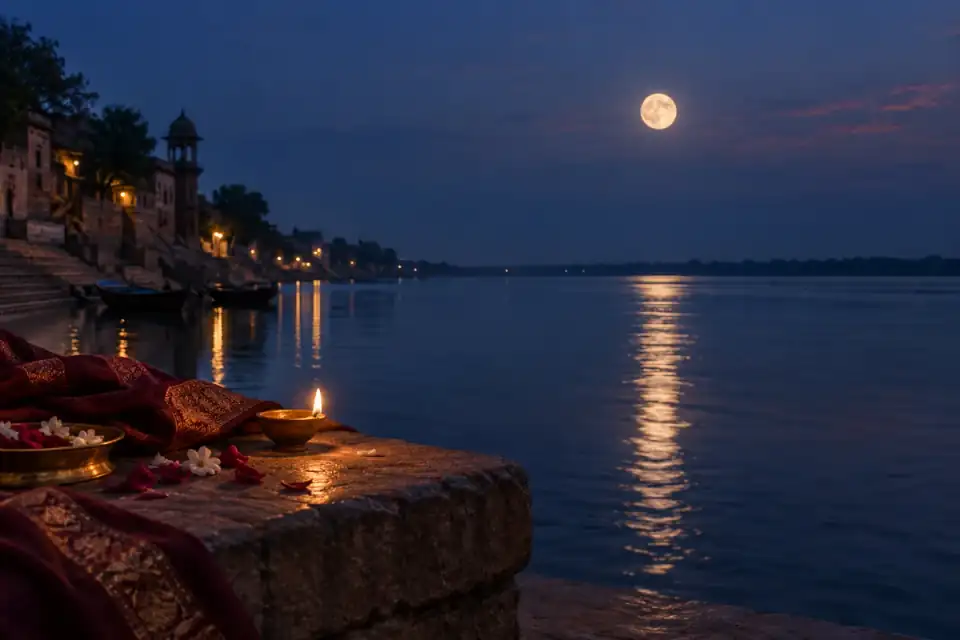
You could have gone outside on 31 May 2026 expecting something blue. The name practically invited it. What appeared, weather permitting, was the familiar full Moon: pale above the roofs, perhaps warm-coloured near the horizon, but under no obligation to resemble its headline.
NASA’s May skywatching notes identified that full Moon as a blue moon because it was the second full Moon within one Gregorian calendar month. The name in this usage describes a calendar arrangement. It does not predict a change in the Moon’s colour, and it does not name a new kind of lunar phase.
The Moon had done what it usually does. Our calendar had made the occasion unusual. That small distinction opens an unexpectedly rich question for an Indian reader: whose calendar are we using when we say the Moon is special?
One Moon, several calendars
The months on an office calendar divide the solar year into familiar boxes. A full Moon belongs to a cycle that does not fit those boxes neatly. Occasionally two full Moons fall within the same named month. The second can receive a memorable label even though nothing has been added to the Moon itself.
Purnima belongs to another way of marking time. In the Hindu calendar, a tithi is defined through the angular relationship between the Sun and Moon, and Purnima is the tithi associated with fullness. It has a beginning and an end that need not coincide with midnight. A household’s observance follows its calendar and tradition, rather than a phrase attached to the Gregorian month.
A blue moon is therefore not a second, more powerful Purnima created by a special celestial mechanism. Nor is it the same thing as an adhika masa, the additional month used in Hindu lunisolar calendrical reckoning. Different calendars solve different problems. Borrowing their most evocative names without their meanings can produce a sky that sounds busier than it is.
The confusion is understandable. Moon names travel beautifully. They fit over a photograph and make a recurring sight seem newly discoverable. Names such as flower moon or snow moon can also carry seasonal associations from cultural settings far from the Indian place in which they are being read. A name can be charming without becoming a rule in Jyotish.
The light a household recognises
There is another kind of naming that happens closer to home. A date on a panchang means a prayer, an observance, a meal prepared differently or a story remembered by someone older. The astronomical event enters the ordinary life of a household. Its significance grows through repetition and relationship.
This is part of what makes Chandra so compelling in the Indian imagination. The Moon is visibly changeable yet reliably returning. Its waxing and waning give the eye a calendar before a page is opened. In Jyotish, its associations with the mind and feeling make that visible rhythm an expressive language for inward experience. Such symbolism does not require every full Moon to carry a new prediction.
A serious astrological interpretation of a particular full Moon would look at the actual sky, the method being used and, for a personal reading, its relationship to the natal chart. The English name blue moon cannot supply that interpretation by itself. An unusual label is not an additional graha.
Yet knowing this need not diminish the occasion. On the contrary, it restores a pleasure that headlines sometimes overlook: the same Moon can be worth watching again. There is no requirement that an evening be unprecedented before we give it our attention.
May’s second full Moon has passed. Another Purnima will bring its own place in the calendar, and another household will make room for it in a familiar way. If you look up, you may recognise nothing that a camera can turn into breaking news. You may still find the night changed by the act of looking.